Basic and Clinical Pharmacology; 14th Edition

Image result for basic and clinical pharmacology 14th edition

Organized to reflect the syllabi in many pharmacology courses and in integrated curricula, Basic & Clinical Pharmacology, Fourteenth Edition covers the important concepts students need to know about the science of pharmacology and its application to clinical practice. Selection of the subject matter and order of its presentation are based on the authors’ many years’ experience in teaching this material to thousands of medical, pharmacy, dental, podiatry, nursing, and other health science students.

To be as clinically relevant as possible, the book includes sections that specifically address the clinical choice and use of drugs in patients and the monitoring of their effects, and case studies that introduce clinical problems in many chapters. Presented in full color and enhanced by more than three hundred illustrations (many new to this edition), Basic & Clinical Pharmacology features numerous summary tables and diagrams that encapsulate important information.

• Student-acclaimed summary tables conclude each chapter
• Everything students need to know about the science of pharmacology and its application to clinical practice
• Strong emphasis on drug groups and prototypes
• NEW! 100 new drug tables
• Includes 330 full-color illustrations, case studies, and chapter-ending summary tables
• Organized to reflect the syllabi of pharmacology courses
• Descriptions of important new drugs
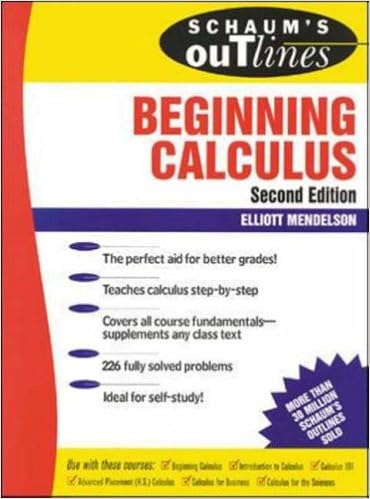

Schaum’s Outline of Beginning Calculus- 2nd Edition

Image result for schaum's outline beginning calculus

Schaum’s Outline of Beginning Calculus- 2nd Edition

 Schaum’s is the key to faster learning and higher grades in every subject. Each Outline presents all the essential course information in an easy-to-follow, topic-by-topic format. You also get hundreds of examples, solved problems, and practice exercises to test your skills.

This Schaum’s Outline gives you:

  • Practice problems with full explanations that reinforce knowledge
  • Coverage of the most up-to-date developments in your course field
  • In-depth review of practices and applications

Fully compatible with your classroom text, Schaum’s highlights all the important facts you need to know. Use Schaum’s to shorten your study time-and get your best test scores!


Schaum’s Outline of Discrete Mathematics- 3rd Edition

Image result for schaum's outline discrete mathematics

Schaum’s Outline of Discrete Mathematics- 3rd Edition

chaum’s is the key to faster learning and higher grades in every subject. Each Outline presents all the essential course information in an easy-to-follow, topic-by-topic format. You also get hundreds of examples, solved problems, and practice exercises to test your skills.

This Schaum’s Outline gives you:

  • Practice problems with full explanations that reinforce knowledge
  • Coverage of the most up-to-date developments in your course field
  • In-depth review of practices and applications

Fully compatible with your classroom text, Schaum’s highlights all the important facts you need to know. Use Schaum’s to shorten your study time-and get your best test scores!

Contents

Chapter 1: Set Theory
Chapter 2:
Relations
Chapter 3:
Functions and Algorithms
Chapter 4:
Logic and Propositional Calculus
Chapter 5:
Techniques of Counting
Chapter 6:
Advanced Counting Techniques, Recursion
Chapter 7:
Probability
Chapter 8:
Graph Theory
Chapter 9:
Directed Graphs
Chapter 10:
Binary Trees
Chapter 11:
Properties of the Integers
Chapter 12:
Languages, Automata, Grammars
Chapter 13:
Finite State Machines and Turing Machines
Chapter 14:
Ordered Sets and Lattices
Chapter 15:
Boolean Algebra


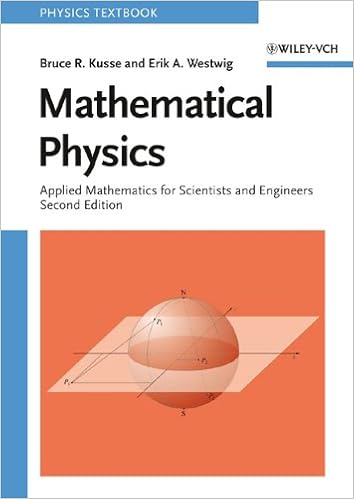
Mathematical Physics: Applied Mathematics for Scientists and Engineers- 2nd Edition

Image result for mathematical physics applied mathematics for scientists and engineers


Mathematical Physics: Applied Mathematics for Scientists and Engineers- 2nd Edition

What sets this volume apart from other mathematics texts is its emphasis on mathematical tools commonly used by scientists and engineers to solve real-world problems. Using a unique approach, it covers intermediate and advanced material in a manner appropriate for undergraduate students. Based on author Bruce Kusse’s course at the Department of Applied and Engineering Physics at Cornell University, Mathematical Physics begins with essentials such as vector and tensor algebra, curvilinear coordinate systems, complex variables, Fourier series, Fourier and Laplace transforms, differential and integral equations, and solutions to Laplace’s equations. The book moves on to explain complex topics that often fall through the cracks in undergraduate programs, including the Dirac delta-function, multivalued complex functions using branch cuts, branch points and Riemann sheets, contravariant and covariant tensors, and an introduction to group theory. This expanded second edition contains a new appendix on the calculus of variation — a valuable addition to the already superb collection of topics on offer. 
This is an ideal text for upper-level undergraduates in physics, applied physics, physical chemistry, biophysics, and all areas of engineering. It allows physics professors to prepare students for a wide range of employment in science and engineering and makes an excellent reference for scientists and engineers in industry. Worked out examples appear throughout the book and exercises follow every chapter. Solutions to the odd-numbered exercises are available for lecturers at http://www.wiley-vch.de/textbooks/.


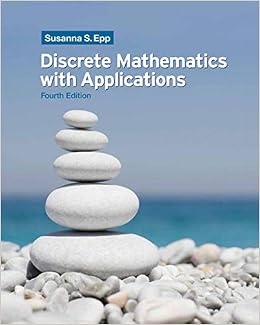
Discrete Mathematics With Applications- 4th Edition

Image result for discrete mathematics with applications

Discrete Mathematics With Applications- 4th Edition

Susanna Epp’s DISCRETE MATHEMATICS WITH APPLICATIONS, FOURTH EDITION provides a clear introduction to discrete mathematics. Renowned for her lucid, accessible prose, Epp explains complex, abstract concepts with clarity and precision. This book presents not only the major themes of discrete mathematics, but also the reasoning that underlies mathematical thought. Students develop the ability to think abstractly as they study the ideas of logic and proof. While learning about such concepts as logic circuits and computer addition, algorithm analysis, recursive thinking, computability, automata, cryptography, and combinatorics, students discover that the ideas of discrete mathematics underlie and are essential to the science and technology of the computer age. Overall, Epp’s emphasis on reasoning provides students with a strong foundation for computer science and upper-level mathematics courses.

Contents

Chapter 1: Speaking Mathematically
Chapter 2: The Logic of Compound Statements
Chapter 3: The Logic of Quantified Statements
Chapter 4: Elementary Number Theory and Methods of Proof Chapter 5: Sequences, Mathematical Induction, and Recursion
Chapter 6: Set Theory
Chapter 7: Functions
Chapter 8: Relations
Chapter 9: Counting and Probability
Chapter 10: Graphs and Trees
Chapter 11: Analysis of Algorithm Efficiency
Chapter 12: Regular Expressions and Finite-State Automata


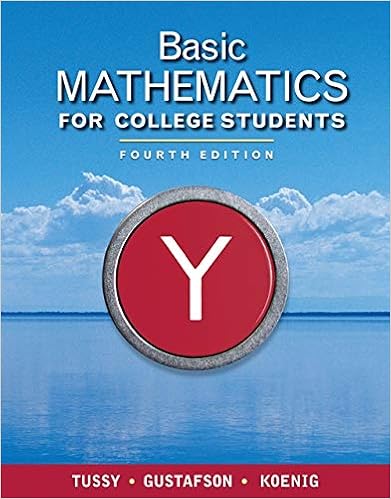
Basic Mathematics for College Students- 4th Edition

Image result for basic mathematics for college students

Basic Mathematics for College Students- 4th Edition

Designed to teach students how to become analytic thinkers through a variety of instructional approaches that embody the recommendations of NCTM and AMATYC, Tussy and Gustafson build the strong mathematical foundation necessary to give students confidence to apply their newly acquired skills at home or on the job. In this thorough review of arithmetic and geometry, the authors also introduce the fundamental algebraic concepts that students who intend to take an introductory algebra course in the future will need.

Contents

Chapter 1: Whole Numbers
Chapter 2:
The Integers
Chapter 3:
Fractions and Mixed numbers
Chapter 4:
Decimals
Chapter 5:
Ratio, Proportion, and Measurement
Chapter 6:
Percent
Chapter 7:
Graphs and Statistics
Chapter 8:
An Introduction to Algebra
Chapter 9:
An Introduction to Geometry


Physical Chemistry- 3rd Edition

Image result for Physical Chemistry- 3rd Edition

Physical Chemistry- 3rd Edition- Robert G. Mortimer

Contents

Chapter 1 The Behavior of Gases and Liquids
Chapter 2 Work, Heat, and Energy: The First Law of
Thermodynamics
Chapter 3 The Second and Third Laws of Thermodynamics:
Entropy
Chapter 4 The Thermodynamics of Real Systems
Chapter 5 Phase Equilibrium
Chapter 6 The Thermodynamics of Solutions Chapter 7 Chemical Equilibrium
Chapter 8 The Thermodynamics of Electrochemical Systems
Chapter 9 Gas Kinetic Theory: The Molecular Theory of Dilute Gases at
Equilibrium
Chapter 10 Transport Processes
Chapter 11 The Rates of Chemical Reactions
Chapter 12 Chemical Reaction Mechanisms I: Rate Laws and
Mechanisms
Chapter 13Chemical Reaction Mechanisms II: Catalysis and Miscellaneous
Topics
Chapter 14 Classical Mechanics and the Old Quantum Theory
Chapter 15 The Principles of Quantum Mechanics. I. De BroglieWaves and
the Schrödinger Equation
Chapter 16 The Principles of Quantum Mechanics. II. The Postulates of
Quantum Mechanics
Chapter 17 The Electronic States of Atoms. I. The Hydrogen Atom
Chapter 18 The Electronic States ofAtoms. II.The Zero-OrderApproximation
for Multielectron Atoms
Chapter 19The Electronic States of Atoms. III. Higher-Order
Approximations
Chapter 20 The Electronic States of Diatomic Molecules Chapter 21 The Electronic Structure of Polyatomic Molecules
Chapter 22 Translational, Rotational, and Vibrational States of Atoms and
Molecules
Chapter 23 Optical Spectroscopy and Photochemistry
Chapter 24 Magnetic Resonance Spectroscopy
Chapter 25 Equilibrium Statistical Mechanics I. The Probability
Distribution for Molecular States
Chapter 26 Equilibrium Statistical Mechanics. II. Statistical
Thermodynamics
Chapter 27 Equilibrium Statistical Mechanics. III. Ensembles
Chapter 28 The Structure of Solids, Liquids, and Polymers
C


Physical Chemistry: Understanding our Chemical World

Physical Chemistry: Understanding our Chemical World- Paul Monk

Understanding Physical Chemistry is a gentle introduction to the principles and applications of physical chemistry. The book aims to introduce the concepts and theories in a structured manner through a wide range of carefully chosen examples and case studies drawn from everyday life. These real-life examples and applications are presented first, with any necessary chemical and mathematical theory discussed afterwards. This makes the book extremely accessible and directly relevant to the reader.

Aimed at undergraduate students taking a first course in physical chemistry, this book offers an accessible applications/examples led approach to enhance understanding and encourage and inspire the reader to learn more about the subject.

  • A comprehensive introduction to physical chemistry starting from first principles.
  • Carefully structured into short, self-contained chapters.
  • Introduces examples and applications first, followed by the necessary chemical theory.

Contents

Chapter 1: Introduction to physical chemistry
Chapter 2:
Introducing interactions and bonds
Chapter 3: 
Energy and the first law of thermodynamics
Chapter 4:
Reaction spontaneity and the direction of thermodynamic change
Chapter 5:
Phase equilibria
Chapter 6:
Acids and Bases
Chapter 7:
Electrochemistry
Chapter 8:
Chemical kinetics
Chapter 9:
Physical chemistry involving light: spectroscopy and photochemistry
Chapter 10:
Adsorption and surfaces, colloids and micelles


Introduction to Computer Science Using Python: A Computational Problem-Solving Focus

Introduction to Computer Science Using Python: A Computational Problem-Solving Focus

Introduction to Computer Science Using Python: A Computational Problem-Solving Focus,recommended by Guido van Rossum, the creator of Python (“This is not your average Python book…I think this book is a great text for anyone teaching CS1”). With a focus on computational problem solving from Chapter 1, this text provides numerous hands-on exercises and examples, each chapter ending with a significant-size program demonstrating the step-by-step process of program development, testing, and debugging. A final chapter includes the history of computing, starting with Charles Babbage, containing over 65 historical images. An end-of-book Python 3 Programmers’ Reference is also included for quick lookup of Python details. Extensive instructor materials are provided for those adopting for classroom use, including an instructors’ manual, over 1,000 well-developed slides covering all fundamental topics of each chapter, source code, and test bank. 


Fundamentals of Computer Science Using Java

Fundamentals of Computer Science Using Java- David Hughes

Fundamentals Of Computer Science Using Java Uses An Object-Based Approach To The Introduction Of Computer Science Using Java As The Programming Language. The Book Is Example-Based With Approximately 50 Completely Worked Examples. The Use Of A Turtle Graphics Library Allows Early Examples And Exercises To Be Interesting While Still Simple. The Use Of A Basic I/O Library Allows I/O Without Having To Deal With Exceptions And Formatting, As Would Be The Case In The Standard Library.


Encyclopedia of Computer Science and Technology- 9th Edition

Encyclopedia of Computer Science and Technology- 9th Edition

Encyclopedia of Computer Science and Technology bridges the gap between scanty “computer glossaries” with brief definitions and dense multi-volume compendiums geared to the scientific and engineering communities. It features more than 400 cross-referenced entries (each with its own further reading sources) that detail a topic’s significance and development in computer science or technology and its relation other topics. To articulate the main themes of the reference and to aid the reader in managing time, the introduction features a complete listing of the entries grouped into specific categories, including fundamental ideas of computing, development of computers, computer architecture, personal computer components, computer languages, operating systems, software development and engineering, graphics and multimedia, and the World Wide Web.
The encyclopedia also includes four helpful appendixes – bibliographies and Web resources, a chronology of discoveries in computer science or technology, a selection of significant awards, and computer-related organizations – as well as an extensive index.


Discrete Mathematics for Computer Science

Discrete Mathematics for Computer Science

An increasing number of computer scientists from diverse areas are using discrete mathematical structures to explain concepts and problems. Based on their teaching experiences, the authors offer an accessible text that emphasizes the fundamentals of discrete mathematics and its advanced topics. This text shows how to express precise ideas in clear mathematical language. Students discover the importance of discrete mathematics in describing computer science structures and problem solving. They also learn how mastering discrete mathematics will help them develop important reasoning skills that will continue to be useful throughout their careers.


Design a site like this with WordPress.com
Get started